
Industry News
Revolution Medicines' Daraxonrasib Delivers Landmark Pancreatic Cancer Results, Signaling Massive RAS Inhibitor API Demand
Pancreatic cancer has long been considered one of the most treatment-resistant malignancies in oncology, with a five-year survival rate that has historically remained below 12 percent. Now, a breakthrough from Revolution Medicines is fundamentally reshaping how researchers and clinicians think about treating this devastating disease — and creating significant new demand signals for pharmaceutical suppliers and API manufacturers worldwide.
Daraxonrasib, Revolution Medicines' novel RAS(ON) inhibitor, has demonstrated clinical results that leading oncologists are comparing to the arrival of the first immune checkpoint inhibitors more than a decade ago. Speaking at a pancreatic cancer conference in London, Dr. Talia Golan of Israel's Sheba Medical Center described the drug's recent trial performance as "one of those moments" that marks a genuine inflection point in cancer treatment. The conference organizers hastily added a dedicated session to discuss the implications of the data.
The significance of targeting RAS proteins cannot be overstated. RAS mutations — including KRAS, NRAS, and HRAS — are found in approximately 25 percent of all human cancers, making them the most frequently mutated gene family in oncology. KRAS mutations alone drive roughly 90 percent of pancreatic ductal adenocarcinomas, the most common form of pancreatic cancer. For decades, RAS proteins were considered "undruggable" due to their smooth molecular surface and picomolar binding affinity for GTP, which left no obvious pocket for small-molecule inhibitors to engage.
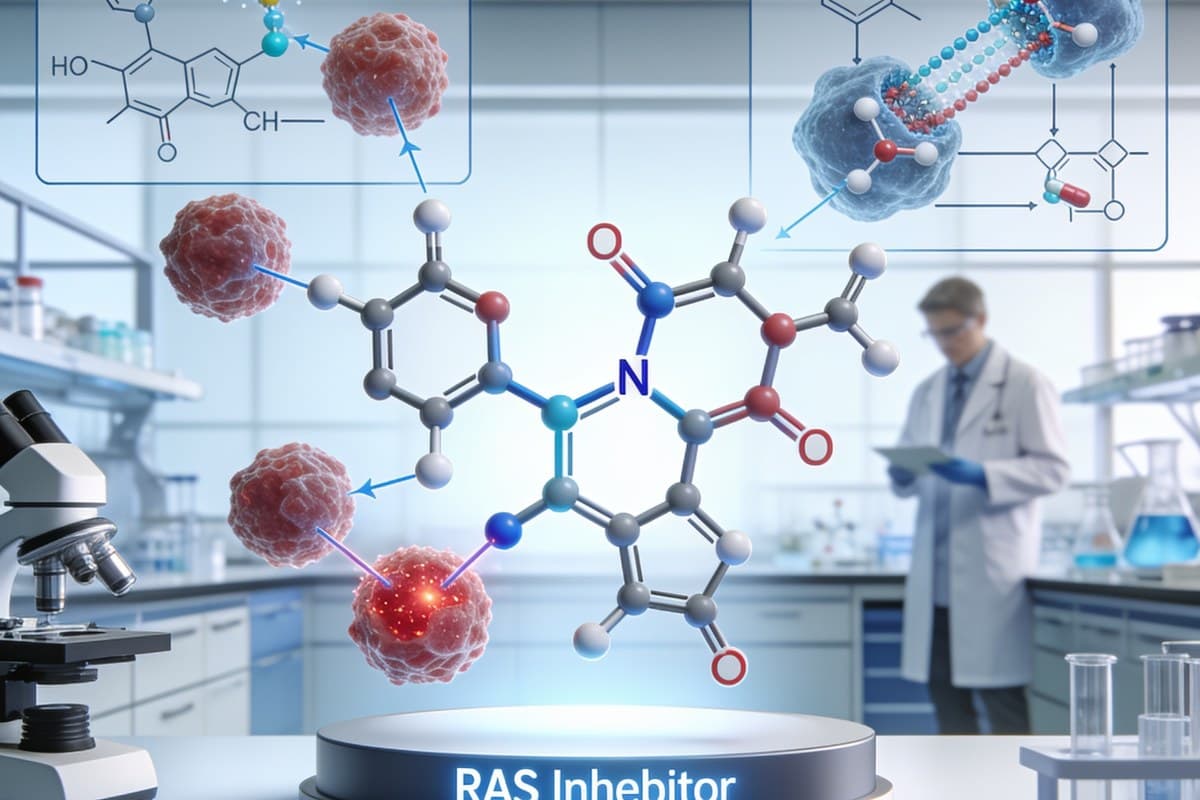
Revolution Medicines succeeded where many others failed by developing a tri-complex inhibitor mechanism that locks RAS in its active GTP-bound state while simultaneously recruiting cyclophilin to create a steric blockade. This innovative approach allows daraxonrasib to inhibit multiple RAS variants, not just the G12C mutation that Amgen's Lumakras and BMS's Krazati target. The broader mutation coverage is particularly relevant for pancreatic cancer, where G12D, G12V, and other non-G12C variants predominate.
For pharmaceutical API suppliers and contract manufacturers, the expected launch of daraxonrasib carries substantial supply chain implications. The drug's potential indications extend well beyond pancreatic cancer. Revolution Medicines is pursuing clinical development across multiple RAS-driven tumor types, including non-small cell lung cancer, colorectal cancer, and other solid tumors. If approved across these indications, annual peak sales estimates could reach $5 billion to $8 billion, according to analyst projections, which would require massive scale-up of active pharmaceutical ingredient production.
The manufacturing complexity of daraxonrasib also creates opportunities for specialized CDMO partners. As a novel tri-complex inhibitor with a complex stereochemistry, the drug requires sophisticated synthetic routes and stringent quality control. Intermediate suppliers capable of producing high-purity cyclophilin-binding pharmacophores and RAS-engaging scaffolds are likely to see increased demand as Revolution Medicines scales from clinical to commercial supply.
The pancreatic cancer treatment landscape is simultaneously being reshaped by several other developments. Combination strategies involving RAS inhibitors with chemotherapy, checkpoint inhibitors, and other targeted agents are under active investigation. Each combination approach multiplies the API demand picture, as patients may receive daraxonrasib alongside established regimens of gemcitabine, nab-paclitaxel, or FOLFIRINOX. This combinatorial paradigm means that the total addressable API market grows not just from new patient starts on the RAS inhibitor itself, but from the broader treatment protocols it enables.
The global regulatory pathway for daraxonrasib is being closely watched. The FDA has granted Breakthrough Therapy Designation for the drug in previously treated KRAS-mutated pancreatic cancer, and Revolution Medicines is expected to submit a New Drug Application in the coming months. The European Medicines Agency and China's NMPA are also anticipated to receive filings, creating a multi-market launch scenario that will require coordinated global API supply chains.
For B2B pharmaceutical suppliers, the daraxonrasib story illustrates a broader trend in oncology: the drugging of previously intractable targets is unlocking entirely new therapeutic categories and expanding the overall API market. Suppliers with expertise in complex small-molecule synthesis, high-potency API handling, and GMP-grade intermediate production are particularly well-positioned to capture value as RAS inhibitors move from clinical promise to commercial reality.
The coming quarters will be critical. As Revolution Medicines prepares for regulatory submissions and scales its manufacturing network, the pharmaceutical supply chain ecosystem — from raw material suppliers to finished-dose CDMOs — should anticipate a step-change in demand for RAS-related production capabilities. The pancreatic cancer treatment revolution that experts have been waiting for may finally be arriving, and its ripple effects will be felt across the global pharmaceutical manufacturing landscape.
How can we help you?
Receive insights into the latest events and regulatory updates
Sent directly to your email
Get industry insights and Unibest news here
Contact Us →