

Industry News
Amgen's Imdelltra Demonstrates Overall Survival Benefit in First-Line Small Cell Lung Cancer Phase 3 Trial
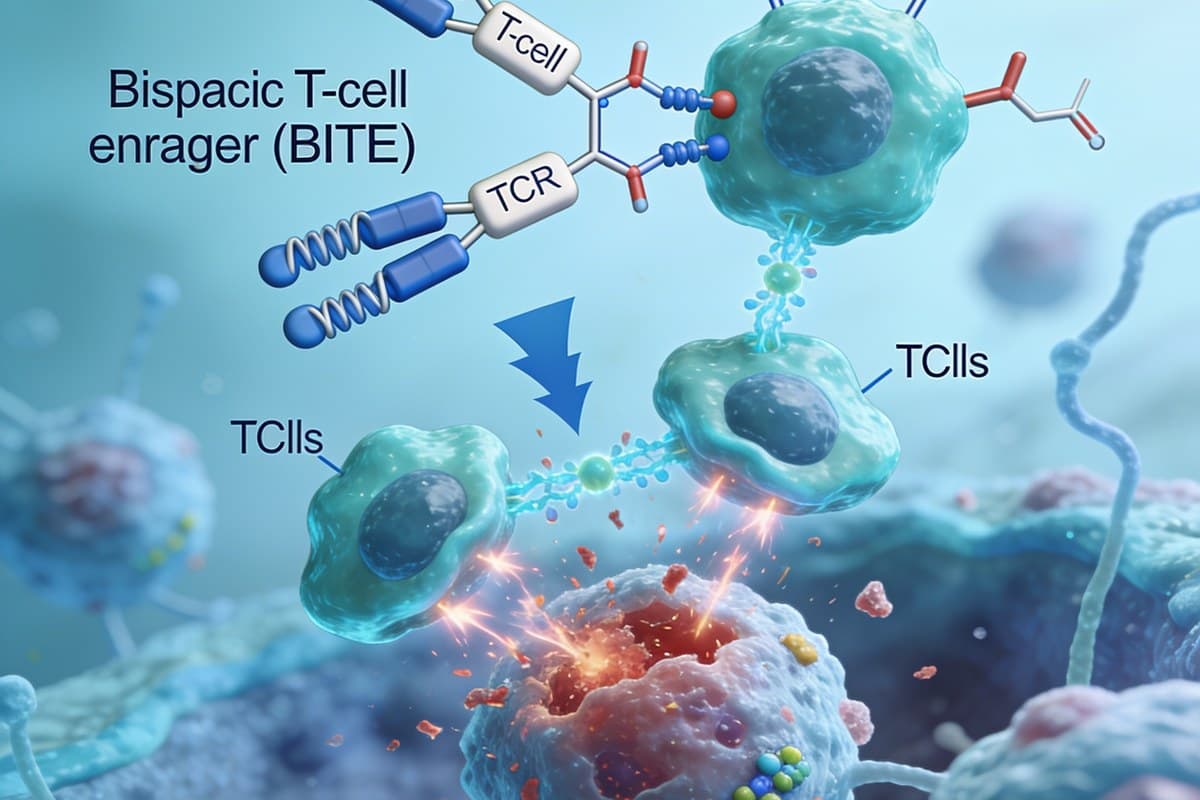
Amgen has reported a significant clinical breakthrough in small cell lung cancer, with its bispecific T-cell engager Imdelltra (tarlatamab) demonstrating an improvement in overall survival when combined with AstraZeneca's checkpoint inhibitor Imfinzi (durvalumab) in patients with extensive-stage disease. The Phase 3 results, presented at the European Society for Medical Oncology congress, mark the first time a T-cell engager has shown an overall survival benefit in a first-line lung cancer setting, a development that could reshape treatment paradigms and create new demand for advanced biologic manufacturing capabilities.
Imdelltra works by simultaneously binding to DLL3 on tumor cells and CD3 on T cells, effectively redirecting the patient's own immune system to recognize and attack cancer cells. DLL3 is highly expressed on small cell lung cancer cells but has limited expression on normal tissues, making it an attractive therapeutic target. The drug was initially approved by the FDA in 2024 for patients with relapsed or refractory extensive-stage SCLC after platinum-based chemotherapy, based on promising response rates in the Phase 2 DeLLphi-301 study. The new Phase 3 data extend these findings into the first-line setting, where the unmet need remains substantial despite the adoption of checkpoint inhibitor combinations as standard of care.
Small cell lung cancer accounts for approximately 13 to 15 percent of all lung cancer cases and is characterized by rapid growth and early metastasis. The five-year survival rate for extensive-stage SCLC remains below 5 percent, and treatment options have been limited for decades. The current standard of care for first-line extensive-stage SCLC is a combination of platinum-based chemotherapy with either atezolizumab (Roche's Tecentriq) or durvalumab (AstraZeneca's Imfinzi), which replaced atezolizumab after Roche withdrew it from the market. Despite these advances, median overall survival remains approximately 12 to 15 months, underscoring the need for more effective therapeutic approaches.
The Phase 3 trial evaluated Imdelltra in combination with Imfinzi and chemotherapy versus Imfinzi plus chemotherapy alone in treatment-naive patients with extensive-stage SCLC. The combination met its primary endpoint of statistically significant improvement in overall survival, a result that Amgen described as transformational for the SCLC treatment landscape. While detailed numerical data are expected to be presented at upcoming medical meetings, the company's characterization of the results as establishing a new standard of care suggests a clinically meaningful survival benefit that could drive rapid adoption.
For the pharmaceutical supply chain, the success of Imdelltra in SCLC has significant manufacturing implications. Bispecific T-cell engagers are complex biologic molecules that require specialized production processes, including precise control of protein folding, bispecific chain pairing, and purification to remove misassembled species. Manufacturing capacity for BiTE molecules has historically been limited, and a first-line approval in SCLC — a large patient population — could substantially increase demand for tarlatamab production. Amgen will likely need to expand its internal manufacturing capacity or engage CDMO partners to meet the anticipated increase in demand.
The broader implications for the bispecific antibody market are also noteworthy. The success of Imdelltra in combination with a checkpoint inhibitor validates the concept of combining T-cell engagers with immunotherapy, a strategy that multiple companies are pursuing across different tumor types. This could accelerate clinical development programs for other bispecific antibodies in lung cancer, breast cancer, and other solid tumors, creating additional demand for specialized biologic manufacturing services. Companies with expertise in bispecific antibody production, including those offering platform technologies for chain pairing and purification, are likely to see increased interest from both large pharma and emerging biotech companies.
Amgen's Imdelltra program also highlights the growing importance of target selection in bispecific antibody development. DLL3 has emerged as a validated target in SCLC, with several other companies pursuing DLL3-directed therapies including ADCs and CAR-T cell therapies. The success of Imdelltra in the first-line setting could stimulate further investment in DLL3-targeted approaches and potentially expand the target's relevance to other neuroendocrine tumors. For API and drug substance suppliers, this represents a diversification of demand beyond traditional small molecule APIs toward increasingly complex biologic modalities that require different manufacturing capabilities and supply chain infrastructure.
The competitive landscape in SCLC is expected to intensify following these results. Roche had previously held a dominant position with atezolizumab before its withdrawal, and AstraZeneca's durvalumab has been gaining market share as the preferred checkpoint inhibitor in SCLC. The addition of Imdelltra to the first-line regimen could further consolidate AstraZeneca's position in this indication while providing Amgen with a significant new revenue stream. For pharmaceutical suppliers, the evolving competitive dynamics in SCLC underscore the importance of maintaining flexible manufacturing capabilities that can respond to shifts in treatment paradigms and the emergence of new therapeutic modalities.
The Imdelltra Phase 3 results also carry implications for the broader immuno-oncology supply chain. As bispecific antibodies move into earlier lines of therapy and larger patient populations, the demand for specialized manufacturing services is expected to grow significantly. The global market for bispecific antibodies is projected to exceed $15 billion by 2030, driven by approvals in hematologic malignancies and the emerging potential in solid tumors. Manufacturing capacity for these complex molecules remains a bottleneck, and companies that can offer scalable, high-quality production of bispecific antibodies will be positioned to benefit from this growth trajectory.
How can we help you?
Receive insights into the latest events and regulatory updates
Sent directly to your email
Get industry insights and Unibest news here
Contact Us →