

Industry News
AbbVie's Etentamig Achieves60% Progression Risk Reduction in Phase 3 Myeloma Trial, Intensifying Bispecific Antibody Manufacturing Demand
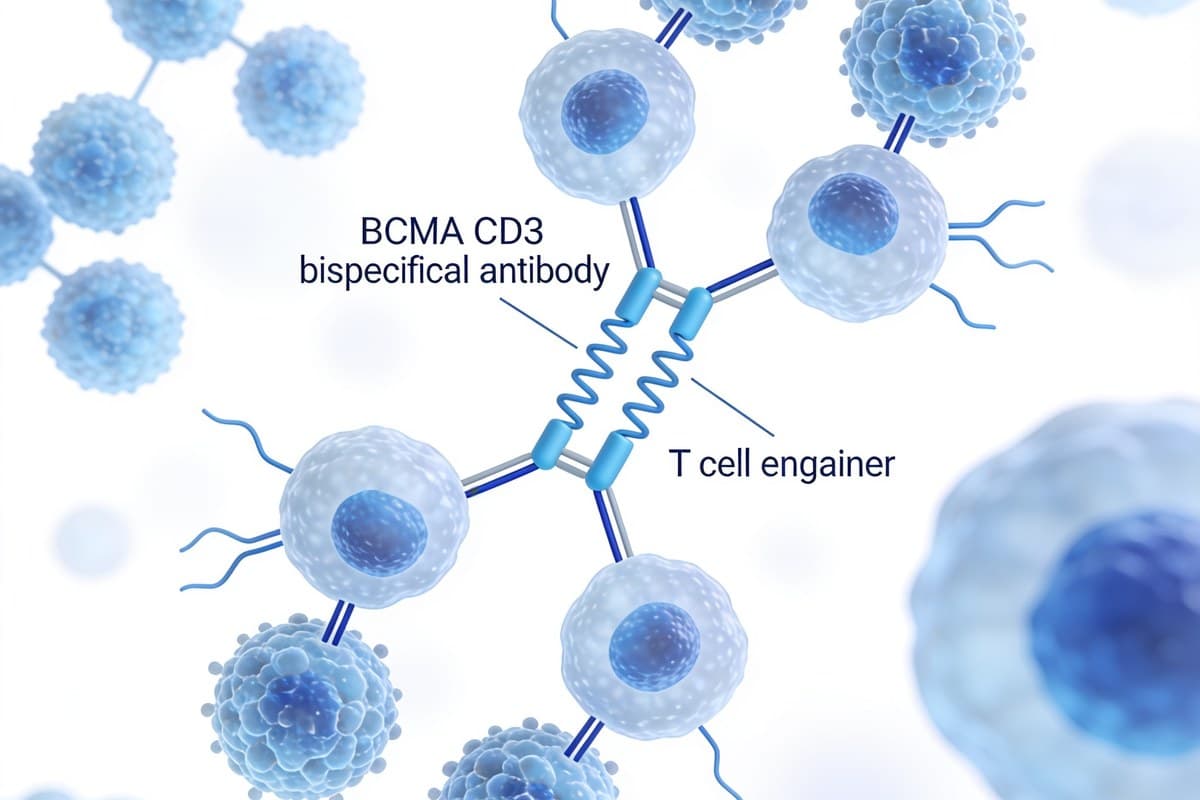
AbbVie has reported positive Phase 3 results for etentamig, its BCMAxCD3 bispecific T cell engager, demonstrating a 60 percent reduction in the risk of disease progression or death in patients with relapsed or refractory multiple myeloma. The CERVINO study, which evaluated etentamig against standard therapies, positions AbbVie to enter an increasingly crowded but commercially significant market for bispecific antibody treatments in blood cancers. For pharmaceutical manufacturers and CDMOs, the result signals accelerating demand for the specialized production capabilities required to manufacture T cell engagers at commercial scale.
Etentamig works by simultaneously binding BCMA on myeloma cells and CD3 on T cells, effectively redirecting the patient's own immune system to attack cancer cells. This dual-binding mechanism is characteristic of the bispecific T cell engager class, which has emerged as one of the most promising therapeutic modalities in hematologic oncology. The 60 percent progression-free survival improvement reported by AbbVie compares favorably with existing approved agents, though the company has emphasized etentamig's differentiated safety profile as its primary competitive advantage over rival products from Johnson and Johnson, Pfizer, and Regeneron.
The multiple myeloma bispecific antibody market is becoming increasingly competitive. Johnson and Johnson's Tecvayli received FDA approval in 2022 as the first BCMAxCD3 bispecific for myeloma, followed by Pfizer's Elrexfio targeting the same pathway. More recently, Regeneron's Lynozyfic entered the market as an alternative BCMA-directed therapy. AbbVie's etentamig will need to demonstrate clear differentiation in either efficacy, safety, or dosing convenience to capture meaningful market share in this crowded landscape. The CERVINO data suggesting a favorable safety profile could be the differentiating factor that drives physician adoption.
For the pharmaceutical manufacturing sector, the proliferation of bispecific T cell engagers creates substantial demand for specialized biologics production infrastructure. Unlike conventional monoclonal antibodies, bispecific molecules require more complex manufacturing processes that can produce heterodimeric proteins with two distinct binding domains. The production yield for bispecific antibodies is typically lower than for standard mAbs, and the purification steps are more demanding due to the need to separate correctly assembled bispecifics from homodimeric byproducts. CDMOs with established bispecific antibody platforms are experiencing strong demand growth as multiple T cell engagers advance through clinical development.
AbbVie's entry into the myeloma bispecific space represents a strategic expansion beyond its existing hematologic oncology franchise, which has been anchored by Imbruvica in chronic lymphocytic leukemia and Venclexta in acute myeloid leukemia. The company's manufacturing infrastructure includes large-scale mammalian cell culture facilities capable of producing bispecific antibodies, though additional capacity investments may be needed to support commercial launch of etentamig across multiple global markets. AbbVie has not yet disclosed specific manufacturing plans, but industry analysts expect the company to leverage both internal facilities and external CDMO partnerships.
The BCMA target has become one of the most validated antigens in multiple myeloma treatment, with approved therapies spanning both bispecific antibodies and chimeric antigen receptor T cell therapies. Bristol Myers Squibb's Abecma and Johnson and Johnson's Carvykti represent the CAR-T approach, while the bispecific antibody class offers an off-the-shelf alternative that avoids the manufacturing complexity and patient waiting times associated with autologous cell therapy. The growing portfolio of BCMA-directed therapies is driving demand for BCMA antigen production, anti-CD3 antibody manufacturing, and the specialized formulation and fill-finish services required for bispecific antibodies.
Multiple myeloma affects approximately 35,000 new patients annually in the United States alone, with the global market for myeloma therapies exceeding $25 billion. Despite significant treatment advances, the disease remains incurable and most patients eventually relapse, creating sustained demand for new therapeutic options. The bispecific antibody class has demonstrated the potential to deepen responses and extend remission durations, which could translate into longer treatment durations and higher per-patient API consumption compared with existing oral therapies like lenalidomide and pomalidomide.
The manufacturing challenges specific to T cell engagers extend beyond the bispecific antibody production itself. These molecules must be formulated at precise concentrations to achieve the desired therapeutic window, as excessive T cell activation can lead to cytokine release syndrome, one of the most common adverse events associated with this drug class. AbbVie's emphasis on etentamig's safety profile suggests the company may have optimized the molecule's binding affinity and pharmacokinetic properties, which could translate into more predictable manufacturing specifications and potentially simpler formulation requirements.
From a supply chain perspective, the growth of the bispecific antibody market is creating new opportunities across the pharmaceutical value chain. Raw material suppliers are seeing increased demand for specialized cell culture media, chromatography resins, and analytical reagents. Contract testing organizations are experiencing growing demand for bispecific-specific potency assays and stability testing protocols. And finished-dose manufacturers are investing in aseptic fill-finish capacity designed to handle the unique handling requirements of bispecific antibody drug products.
As AbbVie prepares for regulatory submissions based on the CERVINO data, the pharmaceutical supply chain should anticipate several downstream effects. Commercial-scale manufacturing of etentamig will require validated production processes at multiple sites to ensure supply continuity. The company's global launch strategy will likely involve technology transfer to regional manufacturing facilities, creating demand for process development and analytical method transfer services. For CDMOs and API suppliers, AbbVie's myeloma bispecific represents another significant opportunity in the rapidly expanding T cell engager manufacturing market.
How can we help you?
Receive insights into the latest events and regulatory updates
Sent directly to your email
Get industry insights and Unibest news here
Contact Us →